
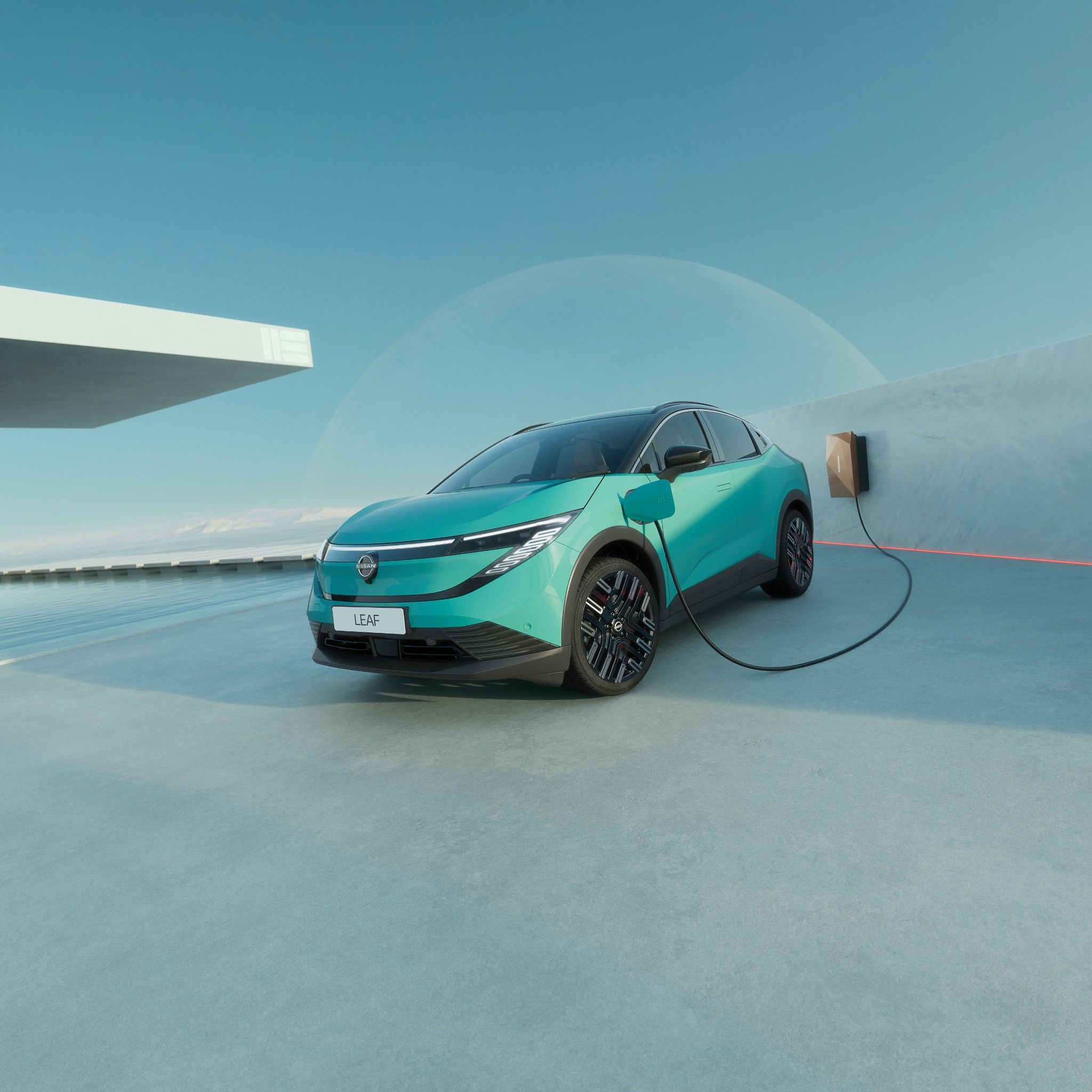
Nissan LEAF Vehicle to grid V2G explained

Nissan LEAF Vehicle-to-Grid (V2G): what's built in, what you still need, and when it goes live?
Here’s the short version:
- Every third-generation Nissan LEAF has V2G hardware built in as standard. No option box, no later model year, no retrofit.
- You'll need two extra things to use it: the dedicated Nissan V2G home charger, and a specific Nissan V2G energy tariff.
- V2G is currently expected to go live in late January 2027. That's Nissan's latest estimate, not a fixed date.
- Vehicle-to-Load (V2L) works today. 3.1kW, standard on every LEAF, nothing extra to buy.
- No monthly subscription to access V2G.
Learn everything you need to know about Vehicle to Grid on this page
What is Vehicle-to-Grid?
Vehicle-to-Grid (V2G) is a two-way charging system that lets an electric car send electricity back to the grid as well as draw it in. Your car stops being purely a thing that consumes energy and becomes a battery your energy supplier can borrow from when national demand peaks.
In practice: you plug in when you get home. Overnight, when power is cheap and there is less people using energy, the car fills up. Late the next afternoon, when the whole country puts the kettle on and prices spike, your LEAF sells a slice of that cheap energy back. You wake up, drive off, and the sums have quietly moved in your favour.
Nissan estimates the system can cut the annual cost of running an EV by around 50%, and reduce charging-related CO2 by roughly 30% a year for an average UK household.
Does every new Nissan LEAF have V2G?
Yes. Every third-generation Nissan LEAF sold in the UK leaves the Sunderland factory with V2G capability built into the vehicle. It isn't a trim-level thing. It isn't an options list thing. There's no "V2G edition" landing in eighteen months that makes today's car look like a bad deal or something to wait on.
This is the single most important fact in the article, so we'll say it plainly. The hardware is in the car already. What hasn't arrived is the equipment and the tariff that sit around it.
Is V2G actually worth the money?
Fair question, and we'd rather point you at somebody else's numbers not just our own.
Octopus Energy already runs a V2G tariff in the UK, separate to anything Nissan is doing. It quotes a typical V2G driver saving £620 a year against its standard flexible tariff, and £161 against its cheapest smart EV tariff. That's modelled on 7,500 miles a year at 0.306 kWh per mile.
Treat those as an indication rather than a promise. Nissan's tariff isn't announced, so nobody can tell you today what a LEAF on the Nissan system will earn. But it does tell you the order of magnitude people are working with, and it's a real figure from a real supplier rather than a manufacturer's press release.
Worth knowing too: V2G isn't some experimental curiosity. The Powerloop trial that tested bundled V2G in British homes was a £7 million project funded through Innovate UK, and formed part of what the funder describes as the world's largest and most diverse V2G demonstration programme. The technology has been through its awkward phase already.
Does every new Nissan LEAF have V2G?
Yes. Every third-generation Nissan LEAF sold in the UK leaves the Sunderland factory with V2G capability built into the vehicle. It isn't a trim-level thing. It isn't an options list thing. There's no "V2G edition" landing in eighteen months that makes today's car look daft.
This is the single most important fact in the article, so we'll say it plainly. The hardware is in the car already. What hasn't arrived is the equipment and the tariff that sit around it.
What you still need to use the Vehicle to Grid on the Nissan LEAF?
Two things, and neither of them lives in the car.
1. The Nissan V2G home charger
This is the part that surprises people, so we'd rather flag it early than have you discover it later. Your LEAF cannot do V2G through a standard home charger. Not an Ohme, not a Pod Point, not any third-party unit. Only the dedicated Nissan V2G charger can pull energy back out of the car. Every one of those other chargers will still charge your LEAF perfectly well through its Type 2 connector. They simply can't run the process in reverse.
If that sounds restrictive, it's worth knowing it's how the whole market works right now, not a Nissan quirk. Octopus's V2G tariff currently supports exactly one combination: a V2G-enabled BYD Dolphin paired with a V2G-enabled Zaptec Pro charger. Bi-directional charging needs the car, the charger and the supplier's systems to agree with each other, and matched pairs are how the industry has got there.
The Nissan charger is due later in 2026, ahead of the system going live. It's sold separately from the car, and pricing will be confirmed nearer launch.
2. A Nissan V2G energy tariff
The export side has to be managed by an energy provider on a tariff built for it. That's what turns exported electricity into money off your bill. Full details, including who's providing it, will be announced before launch. There's no monthly subscription fee for access to V2G itself.
When does Nissan V2G go live?
Nissan's current estimate is late January 2027.
That date has moved, and we're not going to pretend otherwise. Two things shifted it. The launch of the car itself moved, and testing turned up additional complexity in the wider system: the charger, the grid connection and the tariff mechanics all have to work together reliably across thousands of very different houses.
Nissan’s honest view is that they’d rather have a system that works properly in January than one that half-works in October. This is equipment that plugs into the national grid. Not the place to be first and sloppy.
If the estimate moves again, we'll update this page and say so.
My LEAF arrives before then. Should I hold my order?
No, and here's the reasoning rather than just the reassurance.
Because the V2G hardware is already fitted to your car, waiting gains you nothing. There's no improved version coming. A LEAF delivered in September 2026 and a LEAF delivered in March 2027 have identical V2G capability sitting inside them. The only real difference is that one of them spent six months on the road saving you fuel money, while the other one existed as a deposit.
When the charger and tariff go live, the process is simple: buy the charger, get it installed, move onto the tariff, and the capability in your car wakes up. You're not joining a queue behind later buyers. There's no activation fee on the vehicle.

Talk to a Nissan specialist
Our Nissan teams across the Chorley Group have been briefed directly by Nissan on V2G. If your question isn't answered here, ask us.
Who Vehicle to Grid isn't for?
Most articles about this technology skip this bit. We think it's the most useful section on the page, because a customer who buys into V2G and then finds it doesn't suit them is a customer we've let down. However, with the Nissan LEAF, the technology is already installed in every car so there is nothing to lose.
People who already own a home storage battery. The V2G tariff can only manage a single energy storage unit. So it's your home battery or your V2G LEAF, not both. If there's already one on your wall, talk to us before you order rather than after.
People who are rarely parked at home. V2G pays you for availability. Your car has to be plugged in during the evening peak for the system to have anything to work with. As a bit of a yardstick, Octopus asks its V2G customers to be plugged in for around 12 hours a day, on at least 20 days a month. Nissan's requirements aren't published yet, but the underlying logic won't be different. If you're away four nights a week, or you park on the street, the numbers stop working.
People with very high mileage. If you empty the battery most days, there's little spare capacity to sell back. V2G rewards the car that sits still, which is an odd thing to say about a car, but there it is.
Homes with constrained electrical supply. Before installation, the installer checks that your property has sufficient grid capacity for the charger to work effectively. Most homes pass. Older properties with tighter supply are the ones that occasionally need a closer look, and that's exactly what the survey is for.
What your LEAF can do today: Vehicle-to-Load
While V2G waits in the wings, Vehicle-to-Load (V2L) is live from day one, standard on every all-new LEAF, with a 3.1kW output.
V2L turns the car into a large mobile plug socket. Less headline-grabbing than V2G. Considerably more useful on a wet Tuesday than people expect:
- Power tools on a site or an allotment with no supply
- A kettle, lights and a fridge at a campsite
- Keeping the freezer and a couple of lamps running through a power cut
- E-bikes, laptops and everything else on a weekend away
- The garden party where the extension lead was never going to reach
No extra hardware. No tariff. No waiting.
Vehicle to Load and Vehicle to Grid compared
Vehicle-to-Load (V2L) | Vehicle-to-Grid (V2G) | |
What it does | Powers appliances and tools straight from the car | Sends energy back to the grid and your home supply |
Available | Now, from launch | Estimated late January 2027 |
Fitted to | Every all-new LEAF | Every all-new LEAF |
Output | 3.1kW | Confirmed nearer launch |
Extra kit needed | None, it's built in | Nissan V2G home charger |
Extra tariff needed | No | Yes, a specific Nissan V2G energy tariff |
Monthly subscription | No | No |
What about solar panels and Vehicle to Grid working together?
Compatible, and this is the combination that gets the most out of the system. The Nissan V2G setup works alongside a solar installation. You carry on exporting your solar electricity while the charger exports energy from the LEAF. Two income streams, one roof, one driveway.

What to do now
- If your LEAF is on order: carry on. Nothing about the V2G timeline affects your car or your delivery date.
- If you've got a home battery: get in touch before delivery so we can talk through the one-storage-unit limit.
- If you want the charger: register your interest. We can put you in touch with the best EV installers for you.
- If you're still deciding on the car: book a test drive. V2L alone is worth experiencing, and it works today.
- Bookmark this page. We update it whenever the position changes.


£3,500 Deposit Contribution
52kWh Engage 130KW
Dual 12.3" Display Screens, Up to 280 Miles Driving Range, 8 Year Battery Warranty, Includes £3750 EV grant
- Electric
- Automatic
£299/MonthPCP
£2,999 Customer deposit
£28,799


£1,750 Deposit Contribution
52kWh Advance 130kw
Dual 12.3" Display Screens, Up to 280 Miles Driving Range, 8 Year Battery Warranty, Includes £3750 EV grant
- Electric
- Automatic
£359/MonthPCP
£2,999 Customer deposit
£30,712


£3,500 Deposit Contribution
75kWh Engage
Up to 386 Miles Driving Range, Under Luxury Car Tax, 8 Year Battery Warranty, Includes £3750 EV grant
- Electric
- Automatic
£339/MonthPCP
£2,999 Customer deposit
£32,039


£1,750 Deposit Contribution
75kWh Advance
Up to 386 Miles Driving Range, Under Luxury Car Tax, 8 Year Battery Warranty, Includes £3750 EV grant
- Electric
- Automatic
£399/MonthPCP
£2,999 Customer deposit
£33,991
Nissan LEAF V2G: frequently asked questions
Yes. Every third-generation Nissan LEAF sold in the UK has V2G capability built into the vehicle as standard. There's no upgrade to specify and no version to hold out for. Vehicle-to-Load (V2L) is also standard and works from launch.
No. The hardware is already in your car, sitting dormant. When the Nissan V2G charger and tariff go live, currently estimated for late January 2027, you add the charger, move onto the tariff, and the capability wakes up. Ordering now doesn't put you at the back of any queue.
Yes, as long as it has a Type 2 connector. Your existing wall box will charge the car perfectly well. What it won't do is V2G. Only the dedicated Nissan V2G charger can export energy from a LEAF, and no third-party charger is compatible for that.
Because bi-directional charging needs the car, the charger and the energy supplier's systems to work as a matched set. It's how the whole market operates today, not a Nissan restriction. Octopus Energy's V2G tariff, for example, currently supports a single approved combination of one car and one charger.
Nissan's tariff isn't announced, so there's no LEAF-specific figure yet. For scale, Octopus Energy quotes a typical V2G driver on its existing tariff saving £620 a year against its standard flexible tariff, based on 7,500 miles a year. Nissan separately estimates V2G can cut the annual cost of running an EV by around 50%.
Not a thing. The LEAF drives, charges and behaves like any other EV. The V2G tech simply stays dormant. Change your mind in three years and it's still there. You'd just need the Nissan charger unit to use it.
V2L turns the car into a 3.1kW mobile socket. Enough for power tools on site, a kettle and lights at a campsite, a fridge and a few lamps during a power cut, or e-bikes and laptops on a weekend away. No extra hardware, no tariff, no waiting.
The charger is due later in 2026, ahead of the V2G system going live. It's sold separately from the car. Pricing will be confirmed closer to launch. Register your interest with us and we'll come to you first with the numbers.
Most can. Before installation, the installer checks that your property has enough grid capacity for the charger to operate properly. It's a straightforward survey and the vast majority of homes pass without issue.
A standard installation comes with a 5m tethered cable. An 8m cable will also be available if your parking spot is a stretch from the wall.
It's a Nissan-branded unit with its own distinct design, roughly the same size as any other home wall box. It won't dominate the front of the house.
Two reasons, and Nissan has been open about both. The vehicle launch itself moved, and testing uncovered additional complexity in the wider system. Rather than push out something half-finished, Nissan has taken the extra time. The current estimate for go-live is late January 2027. If that moves again, we'll say so here.
No. The V2G tariff can only manage a single energy storage unit, so it's either your home battery or your V2G LEAF, not both. Worth a conversation with us before you order if you've got a battery already.