
Diesel Hits £2 a Litre: What It Means for Your Car's Value and the Switch to Electric
Diesel hit a record UK average of 200.01p a litre on 2 October 2026, the highest price ever recorded, which means filling a typical 55-litre family car now costs £110.01, or £31.70 more than at the end of February. Government figures show diesel has climbed 56p a litre since then, against 42p for petrol. Used diesel values have dipped for five months running and diesels are taking longer to sell, while demand for used electric cars is growing fast. Diesel cars aren't being banned and they aren't becoming worthless, but if you've been wondering what yours is worth, now is a sensible time to find out.
Get a free, no-obligation valuation for your diesel →
If you drive a diesel, you've probably already done the maths at the pump. Maybe you've winced at it. A full tank that cost under £80 in February now costs well over a hundred quid, and the gap between diesel and petrol hasn't been this wide in years.
So what's actually going on? And what does it mean for the car sitting on your drive?
We've pulled together the latest figures from the RAC, the Department for Energy Security and Net Zero (DESNZ), the SMMT and the used car valuation experts at cap hpi. No scaremongering, just the numbers, and what they mean if you live and drive round Lancashire and Greater Manchester.
How much is diesel right now?
Diesel is at a record high. The RAC's Fuel Watch data put the UK average at 200.01p a litre on 2 October 2026, beating the previous record of 199.09p set in June 2022. It's the first time the average has ever gone past £2.
The government's own weekly fuel price figures, which track a slightly different basket of forecourts, tell the same story. In the week of 28 September 2026, DESNZ recorded diesel at 197.58p, already above its own 2022 peak of 194.87p.
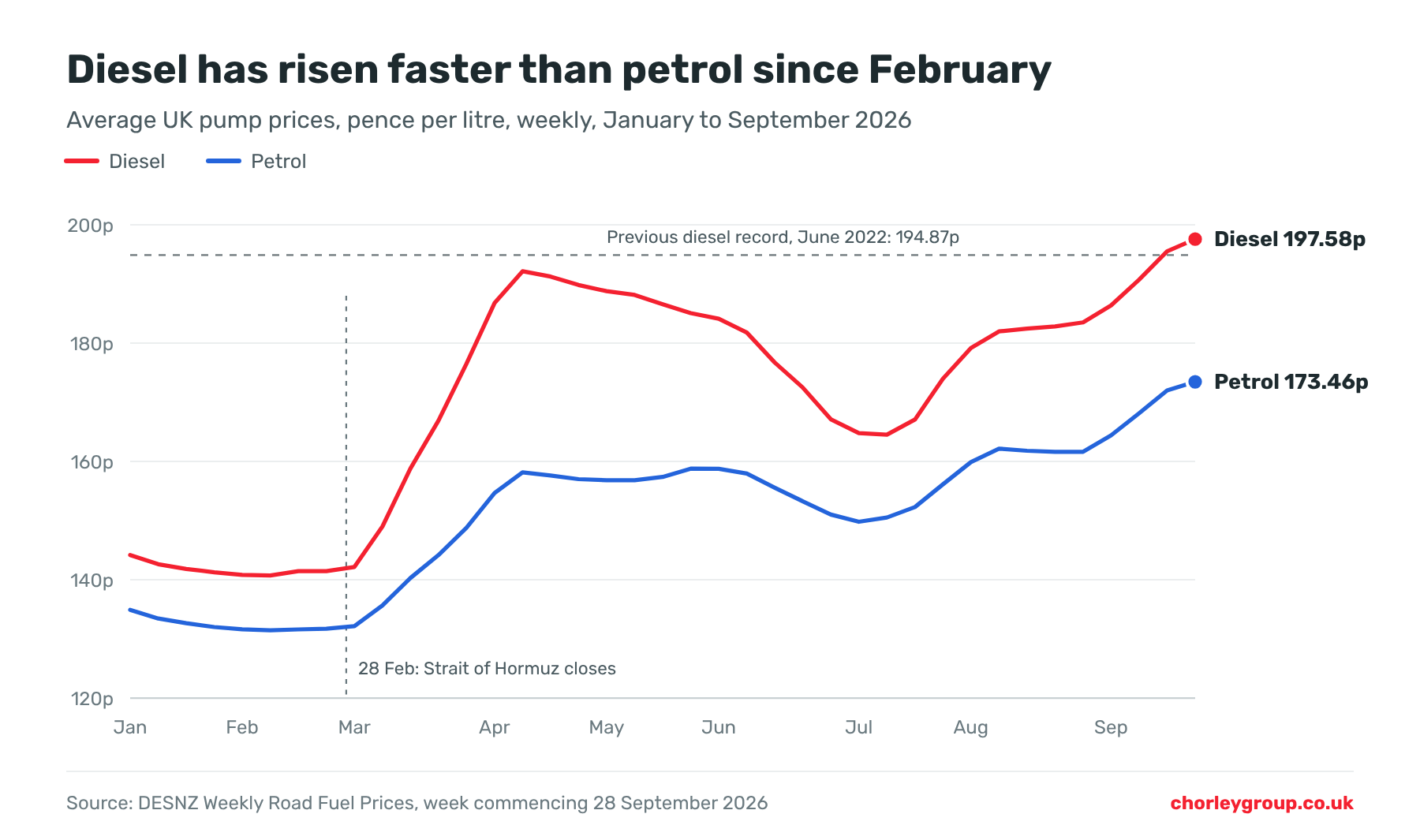
23 Feb 2026 (before the conflict) | 28 Sep 2026 | Change | |
|---|---|---|---|
Diesel (DESNZ) | 141.46p | 197.58p | +56.12p (+39.7%) |
Petrol (DESNZ) | 131.71p | 173.46p | +41.75p (+31.7%) |
Gap between them | 9.75p | 24.12p | Gap has more than doubled |
These figures have come from DESNZ Weekly Road Fuel Prices, week commencing 28 September 2026. RAC Fuel Watch, 2 October 2026.
Simon Williams who is the head of policy at the RAC, didn't mince his words when diesel broke the £2 barrier: "This is a pump price threshold that no-one wanted to cross" and the question on everyones mind is “Is it going to come down any time soon?” Nobody can say for certain.
The RAC has said prices are showing "no signs of slowing", and fuel duty is a factor too. In May the government extended the 5p fuel duty cut to 31 December 2026, which keeps duty at 52.95p a litre for now. Under the current fuel duty rates published by HMRC, the default is a 3p a litre rise on 1 January 2027 and a further 2p on 1 March 2027, although final rates will be confirmed at the Budget.
Why is diesel so much more expensive than petrol?
We have had is question asked to us many times from customers that have come into our showrooms and we simply tell them that it simply comes down to supply. The UK doesn't refine enough diesel for its own needs, so a big chunk of it is imported, and right now refined diesel is in short supply worldwide.
A few things have collided at once:
- The Strait of Hormuz. Conflict involving the US and Iran, which began at the end of February 2026, closed one of the world's most important oil and gas shipping routes. The RAC links the price rises directly to it.
- Refinery disruption. Ukrainian strikes on Russian refineries have squeezed global diesel supply further.
- Where our diesel comes from. Around 30% of the UK's diesel imports come from the United States, and the threat of US restrictions on diesel exports has rattled the market, as reported by Car Dealer Magazine.
Petrol has gone up as well, of course. It just hasn't gone up as much as diesel, and that widening gap is the bit diesel drivers feel every time they fill up.
Get a free, no-obligation valuation for your car →
What it costs to run a diesel car right now?
Price per litre is one thing. What it costs you per tank, per mile and per year is what really matters.
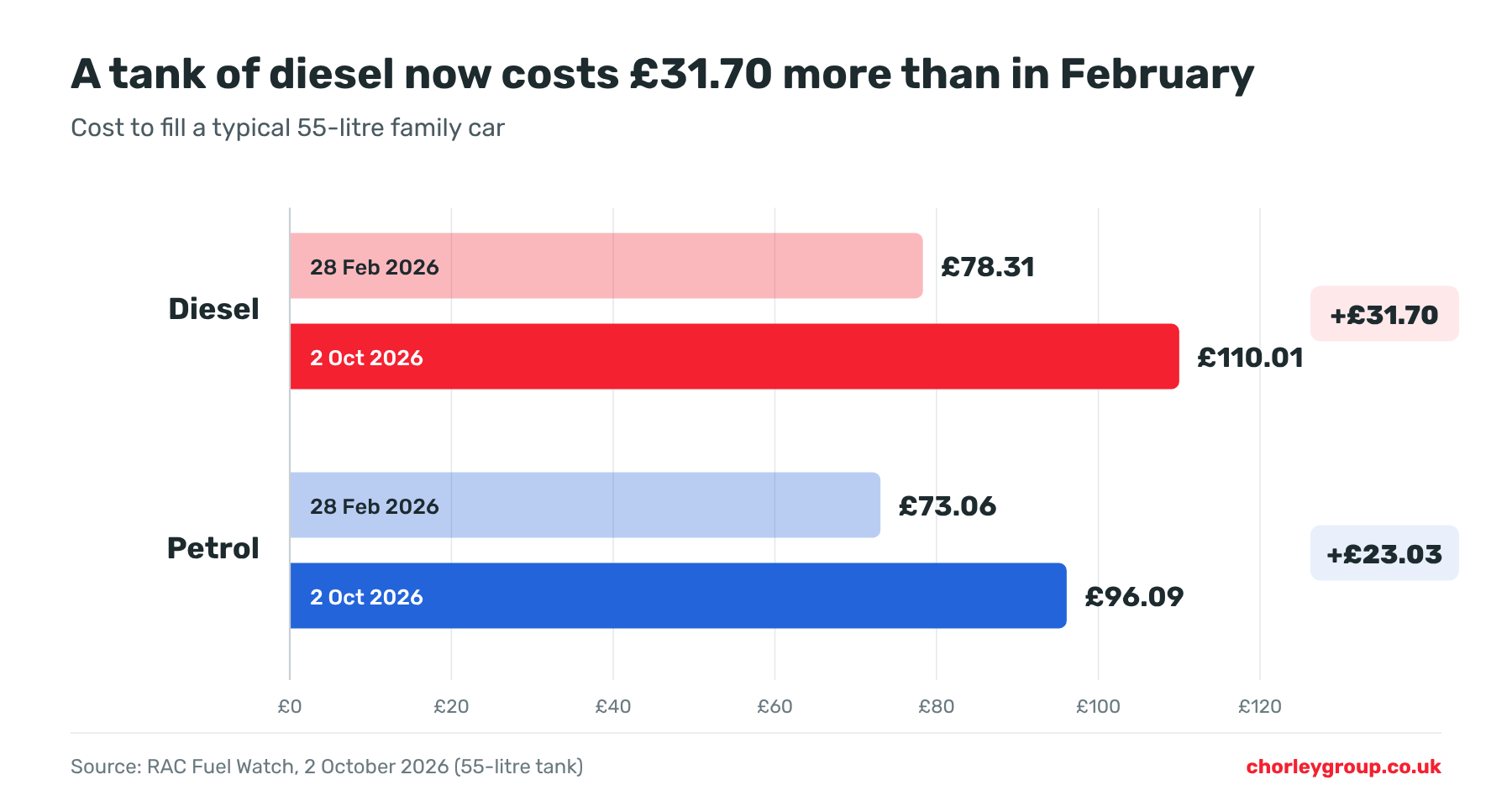
Before the conflict | Now | Extra cost | |
|---|---|---|---|
55-litre diesel fill-up | £78.31 (RAC, 28 Feb) | £110.01 (RAC, 2 Oct) | +£31.70 |
55-litre petrol fill-up | £73.06 (RAC, 28 Feb) | £96.09 (RAC, 2 Oct) | +£23.03 |
Cost per mile, 45mpg diesel | about 14p | about 20p | +6p a mile |
10,000 miles a year, 45mpg diesel | about £1,430 | £2,020 | about +£590 |
20,000 miles a year, average diesel (What Car?) | £2,685 | £3,772 | +£1,087 |
These figures above was collected by RAC Fuel Watch, 2 October 2026; What Car? data reported by Car Dealer Magazine, 30 September 2026. Per-mile figures calculated using DESNZ and RAC prices; see the note at the end.
For a lot of drivers round the Chorley area, that last row is the one that stings. Commute from Chorley to Manchester, run up and down the M6, or do school runs and weekend trips on top, and 20,000 miles a year isn't unusual. That's over a thousand pounds more than you were paying at the start of the year, for exactly the same journeys.
In the RAC's words, diesel vehicles "are now burning a hole in people's pockets".
Diesel vs electric: how do the running costs compare?
It's the question a lot of diesel drivers are asking right now. Here's an honest comparison, based on a typical diesel at 45mpg and a typical EV covering 3.5 miles per kWh (the same efficiency figure used by RAC Charge Watch).
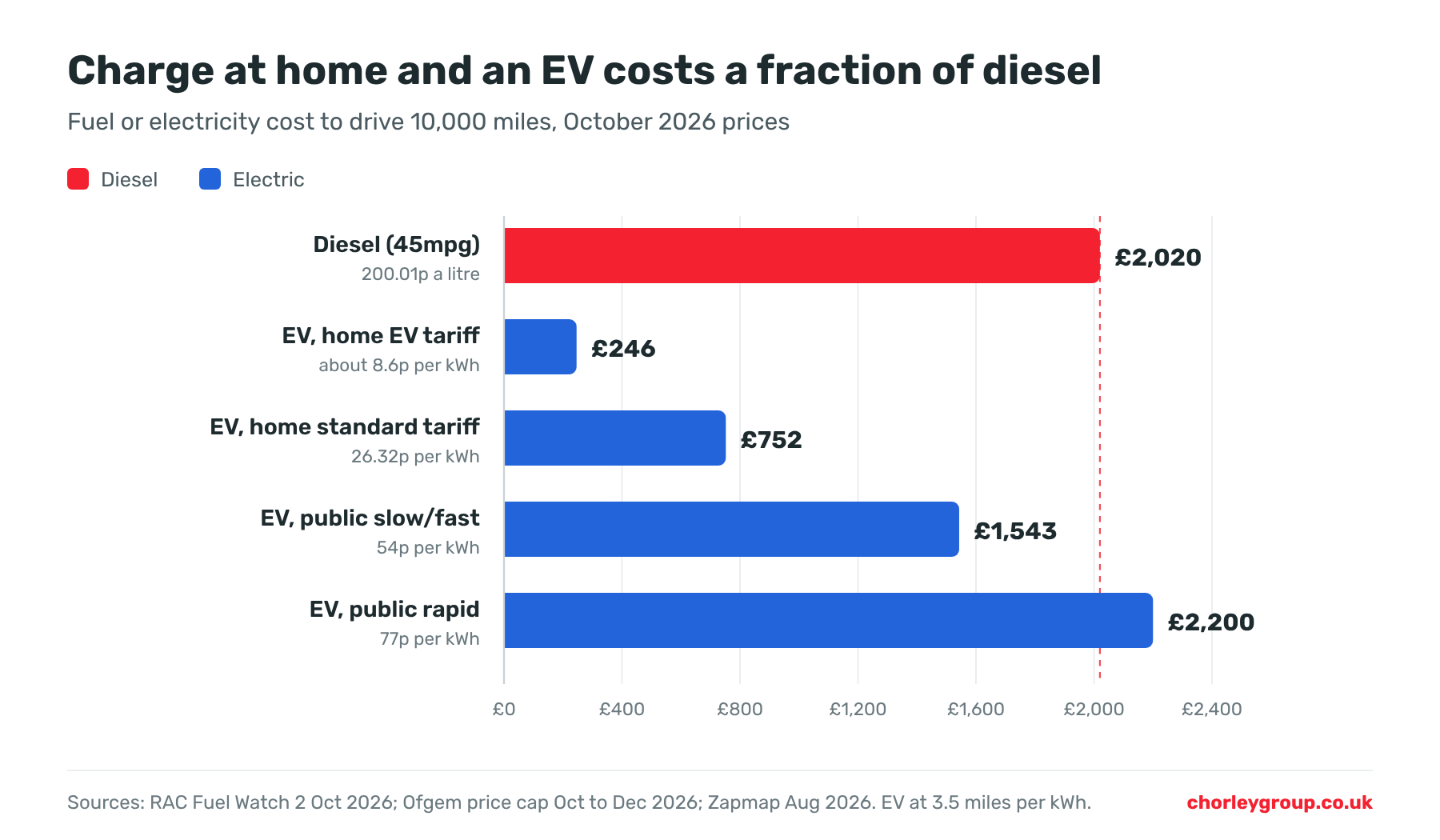
ow you fuel it | Price | Cost per mile | Cost for 10,000 miles |
|---|---|---|---|
Diesel at the pump | 200.01p/litre | 20.2p | £2,020 |
EV, home charging on an EV tariff | about 8.6p/kWh (estimate) | 2.5p | £246 |
EV, home charging on the standard price cap | 26.32p/kWh | 7.5p | £752 |
EV, public slow and fast chargers | 54p/kWh | 15.4p | £1,543 |
EV, public rapid and ultra-rapid chargers | 77p/kWh | 22.0p | £2,200 |
A couple of things are worth pointing out, because they matter:
- Where you charge makes all the difference. If you can charge at home on an EV tariff, running an electric car costs roughly an eighth of what diesel does per mile. Even on a standard tariff, it's well under half. The government has also removed VAT from household electricity bills from 1 October 2026, which helps. Our guide to charging an electric car at home explains how to get set up.
- Rapid public charging isn't cheaper than diesel. If you'd be relying on motorway rapid chargers for most of your miles, the saving disappears. EVs make the most financial sense for drivers with a driveway or access to a home charger.
- The rules are changing in 2028. From 1 April 2028 the government will introduce Electric Vehicle Excise Duty (eVED), a pay-per-mile charge of 3p a mile for electric cars and 1.5p for plug-in hybrids. Add that on and home charging on an EV tariff works out at about 5.5p a mile. Still a fraction of diesel's 20p.
The electric car market is growing faster than ever
UK drivers are reacting to the rise of costs around petrola and diesel, and the registration figures show it.
New Car Sales
September is always a big month thanks to the new number plate, but September 2026 was something else. According to the SMMT's September figures:
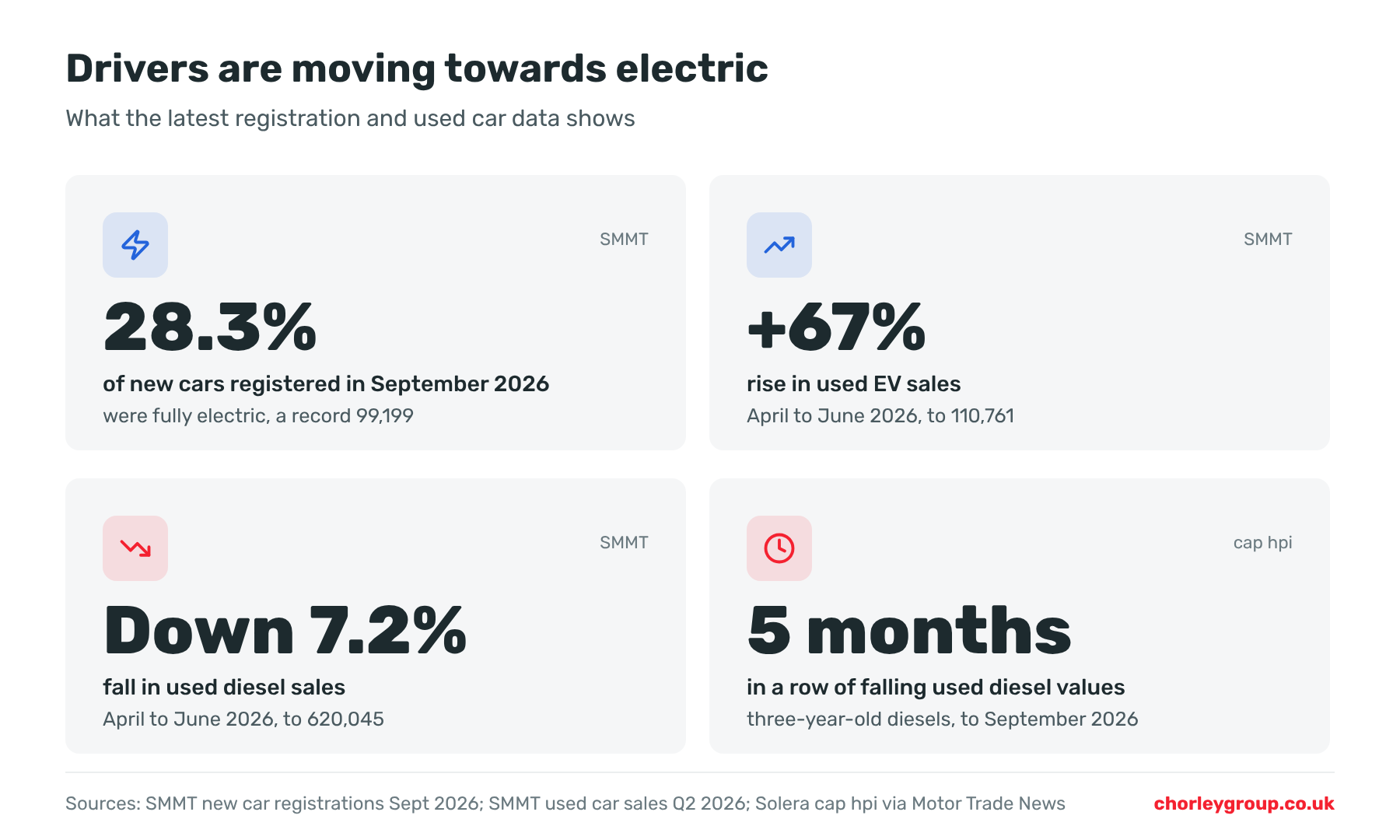
- 99,199 new battery electric cars were registered, a record for any single month and up 36.3% on last year
- EVs took 28.3% of the new car market, with plug-in hybrids taking another 17%
- Together with hybrids, electrified cars made up 58.4% of all new registrations, also a record
- Diesel made up just 4% of new cars registered, according to Carwow's breakdown of the SMMT data
Over the year 2026 so far, EVs account for 26.2% of new cars, up from 20.2% at the same point last year. That's still below the 33% the government's Zero Emission Vehicle (ZEV) mandate requires for 2026, which means manufacturers have every reason to keep pushing EV deals over the winter. You can see what's currently available on our electric car offers pages.
Used Car Sales
The shift is even more striking on the second-hand market. SMMT data for April to June 2026 showed:
- One in 18 used car buyers chose an EV, up from one in 30 a year earlier
- Used hybrid sales rose 31.2%
- Used diesel sales fell 7.2% to 620,045
There are now more than 2 million zero emission cars licensed on UK roads, according to Department for Transport figures for June 2026, up 34% in a year.
If you're considering a new EV, the government's Electric Car Grant takes up to £3,750 off eligible models. The official list of eligible cars includes the Nissan LEAF and the Nissan MICRA 52kWh, both of which you'll find at our Nissan dealerships.
Find our what your car is worth now →
What's happening to used diesel values?
Talking about the state of the used car market right now, here's the bit most diesel owners want to know.
Used diesel prices are softening, not collapsing. The monthly valuation data from Solera cap hpi, the figures the motor trade uses to price used cars, showed three-year-old diesels dropped 0.6% in September 2026, as reported by Motor Trade News. It was the fifth month in a row that diesel values had fallen. Over the same month, used EVs rose 0.3% and hybrids rose 0.5%.
Chris Plumb, head of current valuations at cap hpi, put it simply: "Fuel prices are clearly influencing what people are prepared to buy. Diesel at around 195p a litre is difficult to ignore, particularly when it is so much more expensive than petrol."
Demand tells the same story. Car Dealer Magazine reported at the end of September that:
- Used diesels are now taking 34 days to sell, three days longer than a year ago
- Used EVs are selling around a week faster than diesel equivalents
- Diesel's share of buyer enquiries has halved, while EV enquiries now make up around one in four
Put plainly, fewer buyers are looking for diesels, and the ones who are looking are taking their time. When cars take longer to sell, values tend to drift.
That said, let's keep it in proportion. Diesel still accounted for around 31% of all used cars sold in the second quarter of 2026 (620,045 out of just over 2 million). There's still a big market for good diesels, especially larger SUVs, estates and cars that tow. A well-looked-after diesel with a full service history is still very much a car people want to buy.

Want to know how much your car is worth?
Our online valuation takes a couple of minutes. Pop in your registration and mileage and we'll give you a figure, with no obligation to sell. You can take it as cash or put it towards your next car.
Will diesel cars be worthless in five years?
No, that is the answer. It's one of the most searched questions about diesel right now in the UK, and the honest answer is that there's no evidence pointing that way.
Here's what's actually happening, according to government policy:
- From 2030, the sale of new purely petrol and diesel cars will end. The government confirmed that hybrids can still be sold new until 2035.
- That rule applies to new cars only. You will still be able to drive, buy and sell a used diesel after 2030.
- The government's August 2026 review of the ZEV mandate is consulting on how quickly manufacturers have to hit their targets, but it states clearly that it "will not amend its headline commitment to end the sale of new purely petrol and diesel cars by 2030".
What will change is demand. As more drivers move to electric and hybrid, the pool of people shopping for diesels gets smaller. Values won't fall off a cliff, but the long-term direction for most everyday diesel hatchbacks and small SUVs is gradual rather than sudden decline. The cap hpi data above is an early sign of that.
Still not sure about electric? We've tackled the nine EV myths North West drivers still believe.
Should you sell your diesel car? Questions to ask yourself
There's no one-size-fits-all answer. It depends on how you use your car. These are the questions worth thinking about:
If this sounds like you... | It might make sense to... |
|---|---|
You do lots of long motorway miles and rarely do short trips | Keep a diesel for now. It's still efficient on long runs, and diesel remains a strong choice for towing. |
You mostly do short local journeys, school runs and town driving | Look at a hybrid or EV. Short trips are also tough on a diesel's particulate filter (DPF). |
You have a driveway or can install a home charger | An EV could cut your fuel costs by hundreds, even thousands, a year. |
You'd rely on public rapid chargers for most of your miles | A hybrid may suit you better than a full EV, at least for now. |
Your diesel is coming up for big services, new tyres or a cambelt | Get a valuation first. Spending money on a car you're thinking of changing rarely pays off. |
You're on PCP and nearing the end of your agreement | Find out your settlement figure and get a valuation. You may have equity to put towards your next car. |
Not sure how PCP equity works? Our guide to PCP vs HP vs leasing explains it in plain English.

How to find out what your diesel is worth?
Getting a valuation from Chorley Group is quick and there's no pressure.
- Enter your registration on our valuation page.
- Confirm your mileage and the car's condition.
- Get your figure. It's a guide based on the details you give us. We'll confirm the final price when we see the car, taking into account its condition, service history and how many keys you have.
- Decide what you want to do. Sell it to us for a straight payment, use it as a part exchange against your next car, or simply keep the figure for reference. There's absolutely no obligation.
Still paying finance on it? That's fine, and it's very common. Get a settlement figure from your lender and we'll work out where you stand.
With dealerships in Blackpool, Bolton, Burnley, Chorley, Preston and Wigan, there's a Chorley Group site near you whenever you're ready to talk it through. Find your nearest dealership.
Frequently asked questions
The RAC recorded an average of 200.01p a litre on 2 October 2026, the highest UK diesel price on record. Petrol was 174.71p. Government figures for the week of 28 September 2026 put diesel at 197.58p and petrol at 173.46p.
The UK imports much of its diesel, and refined diesel is in short supply worldwide. The closure of the Strait of Hormuz since February 2026, disruption at Russian refineries and uncertainty over US diesel exports have pushed diesel up faster than petrol. The gap between the two has grown from under 10p a litre in February to more than 24p.
Filling a typical 55-litre family car with diesel costs around £110 at October 2026 prices, according to the RAC. That's £31.70 more than at the end of February 2026.
No. From 2030 you won't be able to buy a brand new purely petrol or diesel car, but existing diesels can still be driven, bought and sold on the used market after that date.
Usually, yes, if you can charge at home. At October 2026 prices, a typical diesel costs around 20p a mile in fuel, compared with about 2.5p a mile for an EV charged at home on an EV tariff, or about 7.5p on the standard price cap. Charging mainly on public rapid chargers can cost slightly more per mile than diesel.
Yes. Ask your lender for a settlement figure and get a valuation. If your car is worth more than you owe, the difference can go towards your next car or be paid to you. If it's worth less, the shortfall can usually be added to a new agreement.
It depends on how you drive. A diesel still makes sense for high-mileage motorway drivers and anyone who tows. If you mostly do short local trips, or could charge an EV at home, switching could save you a lot on fuel. Either way, used diesel values have dipped for five months in a row, so it's worth getting a free valuation to see where you stand before you decide.


